
THE SHORT VERSION
FROM JESSIE
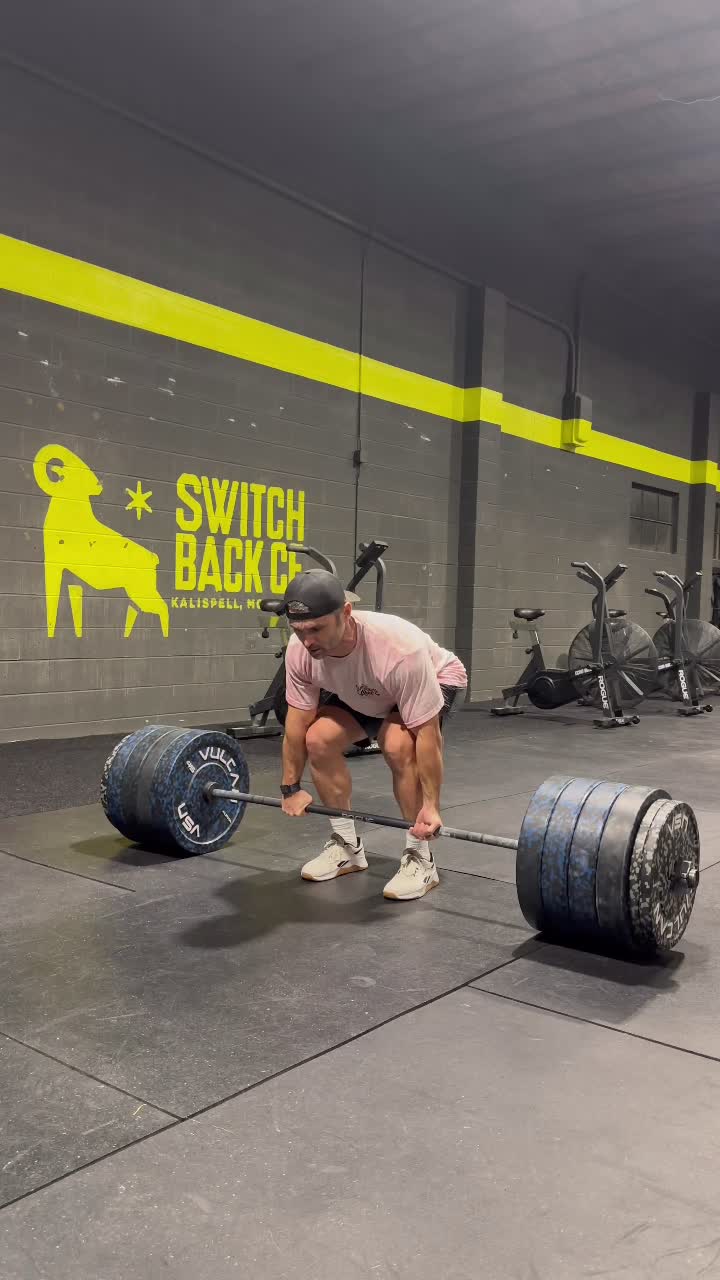
New Year's Eve 2019, I PR'd my deadlift at 470. I was 40 years old. Year after year went by, and I never really came close again. Then in 2024 I qualified for the Masters CrossFit Games. I finished 25th in the world — as strong and fit as I had ever been — and I came home more motivated than ever. That November — November 13, 2024, just over two years ago now — deadlifting heavy, not even maxing, I ruptured my bicep tendon attempting 445. Before the injury, I'd already given up hope of ever PR'ing again. Now it felt certain. I recovered, and I vowed to never use a mixed grip again — even if it meant a weaker deadlift. Seven months later, in June, I pulled 471. One pound over a five-year-old PR. It meant the world. I cried — tears of joy, and pride, and hope. Eleven months after that, in the 2026 Age Group Semifinals, I surprised myself again: 500 pounds, in a 10-minute EMOM. One of the most memorable days of lifting in my life. Both days taught me the same thing. The path is almost never direct. It's filled with ups, downs, and switchbacks. But the only person who decides there's no growth left is you — when you quit.


NOBODY EVOLVES IN A STRAIGHT LINE
Everybody loves the before-and-after photo. Two pictures, side by side, with all the hard parts cropped out.
But that's not how change works — in nature or in the gym. Evolution never happened in a moment. It happened under pressure, repeated over a very long time, most of it invisible while it was happening.
Your training works the same way. You show up for weeks and the scale doesn't move. The bar doesn't move. The skill still feels awkward. That's not failure. That's the middle of the process — the part most people quit in.
Here's what's actually happening in the middle.
YOUR BODY CHANGES IN LAYERS — AND THE LAYERS RUN ON DIFFERENT CLOCKS
First, your nervous system. The earliest strength gains aren't muscle at all. Research going back to Sale's classic 1988 review shows that when you first get stronger, it's mostly your nervous system learning to switch the muscle on harder and coordinate the movement better. You're getting stronger in ways no mirror can show you.
Then, slowly, muscle. In a 2016 study in the Journal of Physiology, untrained men trained for 10 weeks. The big protein-synthesis spike after the first session turned out to be repair — the body fixing damage, not building anything new. Measurable muscle growth didn't appear until week 10. Week one's effort is spent on repair. Growth is what's left after months of showing up.
Last, your tendons. A 2015 meta-analysis of 27 studies found tendons do adapt to training — they get stiffer and stronger — but on a slower clock than muscle, with bigger changes in programs lasting 12 weeks or more, and tendon size barely changing at all. Part of you is always lagging behind the part you can feel. That's not a flaw. It's exactly why progress has to be patient, and why rushing the load is how people get hurt.
And the skills feel awkward the longest. Motor-learning science describes three stages of learning a movement: cognitive (you think through every piece), associative (the pattern is there, and you refine it through practice and feedback — this stage can last a long time), and autonomous (it just runs). A snatch or a kip feeling clumsy for months isn't you failing to learn. It's the middle stage doing its work. Clicking is the last stage, not the first.
James Clear, in Atomic Habits, calls the flat stretch the "Plateau of Latent Potential." His image: an ice cube in a room warming one degree at a time. From 25 degrees to 31, nothing visibly happens. At 32, it melts. "Your work was not wasted; it is just being stored." That's a writer's metaphor, not a study — but anyone who has trained through a plateau knows exactly what it describes.
The American College of Sports Medicine's own progression guidelines treat plateaus as an expected training state, not a verdict. The prescribed response isn't to quit or to panic — it's progressive overload and systematic variation: change the stimulus, keep showing up.
CrossFit's founder made the same point twenty years ago. In "Fundamentals, Virtuosity, and Mastery" (CrossFit Journal, 2005), Greg Glassman defined virtuosity as "performing the common uncommonly well" — and argued that mastery is built by insisting on the fundamentals long after they stop feeling new. Evolution, in the gym, is refinement. Not novelty.
WHAT THIS MEANS AT SWITCHBACK
So — what are you in the middle of right now?
Evolution isn't easy. It was never supposed to be. It's just slow — and it only stops when you do.
* Keep Climbing *
Sources